
Ardennes ’44
The 16th of December, 1944

Turn by Turn • German Perspective
It’s been three weeks since we last sat down with Ardennes ’44. That matters here. This is not a game that forgives a cold engine — Simonitch’s ‘44 system rewards players who live inside its logic continuously. Put it down for three weeks and you’ll might spend the first hour relearning what you thought you already knew. The ZOC bonding rules, the movement modes, the exceptions that makes this title the most rule-dense in the series. Worth every bit of it. But you pay the price when you step away.
We’re playing the full campaign. I’m running the Germans this time — which means I’m the one with the initiative, the momentum, and the brutal arithmetic of a plan that was doomed before the first counter moved. Hitler’s gamble was a fantasy: reach the Meuse, cross it, take Antwerp, split the Allied armies, force a negotiated peace. Every serious student of the war knows this was not achievable. And yet — in those first 36 hours, the Germans came frighteningly close to making a mess of Allied plans even within a failing operational framework. That tension is exactly what Ardennes ’44 captures. It would be cool to see Hurtgen Forest covered and potentially linked.
Turn 1 — Morning, 16 December [recap]
The Opening Guns
0530. The Ardennes erupts.
After days of careful concealment — strict radio silence, night movements, artillery pieces walked into position by hand to avoid the sound of engines — three German armies open up simultaneously along an 85-mile front. Over 1,600 artillery pieces, rocket projectors, and Nebelwerfers tear into the American lines. The attack achieves total tactical surprise.
The Americans had been feeding tired divisions into this sector specifically because nothing ever happened in the Ardennes. It was a rest area. A quiet front. Until it wasn’t.
On the board, Turn 1 AM captures that initial shock. The German machine is at its peak — full supply, trained replacements, armor fuel topped off for what Wehrmacht planners called the “golden hour” before Allied air power grounds everything. The American defenders are thinly spread, understrength, and in several cases genuinely caught off guard.
Three distinct thrusts are underway from the outset. In the north, Sepp Dietrich’s 6th Panzer Army — the SS showpiece, Hitler’s favored instrument — drives toward the Elsenborn Ridge and the roads that feed into Liege. In the center, Hasso von Manteuffel’s 5th Panzer Army, arguably the more professionally competent of the two, punches through the Schnee Eifel and turns its eyes on St Vith and beyond to Bastogne. In the south, Erich Brandenberger’s 7th Army provides the flank screen, driving west with infantry — no armor, limited objectives, a thankless role.
Turn 1 AM sets the clock. From here it’s a race.
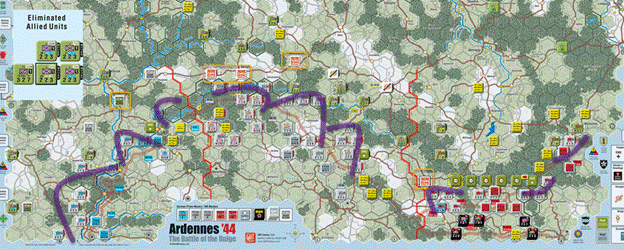
End of Turn 1 AM — German forces erupt across the front. The line holds… for now.
Turn 2 — Afternoon, 16 December
Breakthroughs and Bottlenecks
The afternoon turn tells two different stories depending on which part of the map you’re looking at.
6th Panzer Army — A Better Showing
After a frustrating morning, the 6th Pzr Army finds its teeth in the afternoon. The 1st SS Panzer Division and the 12th SS Panzergrenadier Division, alongside the 3rd Fallschirmjäger, hammer through the American defensive line and force a general retreat back toward the Heppenbach–Elsenborn road. This is meaningful ground. The road network here feeds directly into the northern routes the Germans need to move armor quickly.
Joachim Peiper’s Kampfgruppe — the spear tip of the entire operation in the north — is threading through the chaos, hunting for a clear corridor. Historically, Peiper’s column would become the most famous, and ultimately most tragic, element of the entire offensive. On the board he begins to make the kind of progress that justifies the gamble of giving him the lead.
The Losheim Gap is still blocked by the American 105th. That single fact is doing more damage to the 6th Pzr Army’s timetable than anything else on this half of the map.
And there it is — the Losheim Gap. Historically, this narrow corridor between the Schnee Eifel and the Elsenborn Ridge was the critical hinge on which the northern attack pivoted. In the game it plays the same role or at least a similar role. The American 14th Cavalry Group held this sector and, while they were eventually overrun, they bought time that proved expensive for the German schedule. On our board, the 105th is still in place, and the gap remains closed. Peiper cannot fully exploit until that changes.
5th Panzer Army — The Center Advances
Things look considerably better across Manteuffel’s front. The 62nd Volksgrenadier Division is closing the noose on St Vith, the vital road junction whose fall or survival will define the shape of the entire battle’s middle phase. Historically, the defense of St Vith by the 7th Armored Division and assorted American units constituted one of the great delaying actions of the war. On our map, that fight is about to begin in earnest.
Further west, the 116th Panzer and elements of the 650th, forming the core of the 58th Panzer Corps, have captured the Weisampach crossroads — a useful gain that opens movement options heading toward Houffalize. The 26th Volksgrenadier Division from the 47th Panzer Corps is closing in on Clervaux, where the 110th Infantry Regiment of the 28th Division is preparing the most desperate kind of stand. And Panzer Lehr — one of the finest divisions in the German order of battle, here reduced to picking its way down forest trails because the roads are not yet clear — is working toward Hosingen. Most of 2nd Panzer is across the Our River.
7th Army — The Southern Flank
In the south, the 5th Fallschirmjäger Division and the 352nd Volksgrenadier Division are pushing forward on a broad front, approaching Diekirch and Junglinster. Their job is not to win the battle but to prevent the Americans from reinforcing the center. A thankless mission that matters enormously.
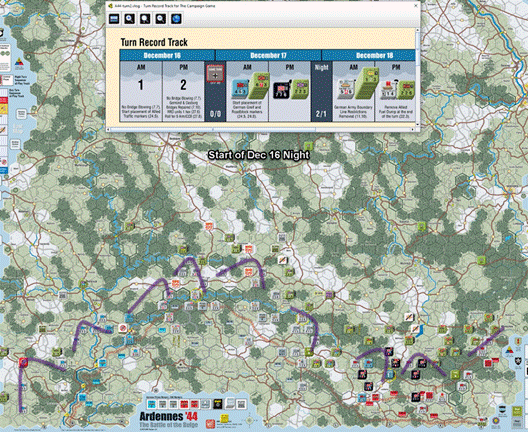
End of Turn 2 PM — The 6th Panzer Army breaks through in the north. St Vith and Clervaux are under threat.
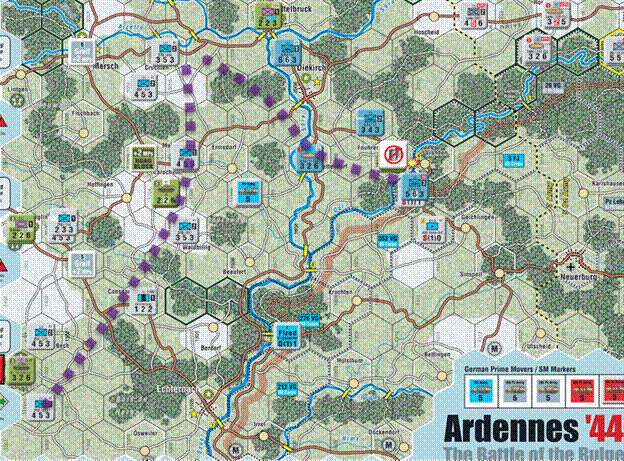
Overview: the front as dusk falls on December 16th. German momentum is building but the critical roads remain contested.
Night Turn — 16–17 December
Peiper Moves in the Dark
The night turn in Ardennes ’44 is brief but consequential. It reflects the reality of winter night operations in the Ardennes — visibility near zero, movement restricted to roads, and the constant risk of running headlong into a roadblock in the dark.
Peiper makes modest headway. ‘Modest’ is doing a lot of work in that sentence. Every kilometer the Kampfgruppe advances tonight is a kilometer closer to the Meuse bridges that represent the operation’s best-case scenario. But the roads are narrow, the night is black and bitter cold, and somewhere ahead American engineers are making decisions about bridges that will either make Peiper a hero or leave his column stranded and surrounded.
Historically, Peiper’s column covered extraordinary distances in the first 24 hours. On the board, we’re managing expectations. The roads are a bottleneck and the clock does not stop.
Turn 3 — Dawn, 17 December
The Machine Grinds Forward
Dawn breaks on Turn 3 and we take stock. The German advance is progressing, but not at the pace the plan demands. This is the moment in almost every Bulge game where the German player feels the first cold fingers of doubt. You’re moving, you’re fighting, you’re taking ground — but are you taking it fast enough?
The Southern Problem
The 21st element moves to ZOC lock position and sets up to potentially attack the units holding the map entry areas. This is one of those moments where the rules of Ardennes ’44 bite back. ZOC locking in this system is not a simple concept — it’s a web of interactions between units, terrain, and movement modes that requires genuine mastery to exploit correctly. We’ve been away from the game for three weeks and it shows.
It’s a bit of a challenge. To put it plainly: we’re relearning as we go, which is not ideal when you’re running the most time-sensitive offensive in the history of the Western Front.
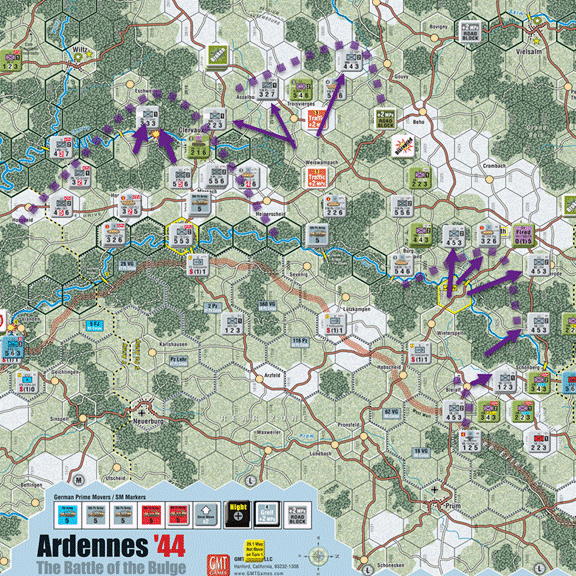
Turn 3 — Southern sector. ZOC lock attempts and the frustrating geometry of the Ardennes trail network.
Lehr Approaches Wiltz
Once through the river crossings and heavy woods zone, Panzer Lehr advances on Wiltz essentially unopposed — for now. Wiltz sits on the road network that feeds into Bastogne from the northeast, and its fall would accelerate German options considerably. But we know what’s coming. American engineer units will arrive and begin doing what American engineers did throughout this battle: blowing bridges, felling trees across roads, and turning every trail junction into a minor tactical problem that costs the Germans time they do not have.
Lehr was one of the finest divisions in the Wehrmacht. In the Ardennes they spent the first two days on forest tracks, unable to use their armor effectively, chewing through fuel they couldn’t replace. The irony of deploying your best armored unit where it can’t operate as armor is peak German operational planning for this campaign.
Clervaux — An Exchange
2nd Panzer and the 22nd Infantry attack into Clervaux and its surrounding hexes. The bridge has been blown but they clear a path regardless, forcing the fight. The result: an exchange. This stings. Clervaux was a key hex in the operational plan — one I specifically targeted early to unlock the routes south and west. An exchange means I’ve paid a cost I didn’t budget for. The 110th Infantry’s stand here, while historically doomed, is exactly as painful in the game as it was in reality. Fuller’s regiment bought time at the cost of its own destruction.
The earlier attack to the north was designed specifically to force a step loss on retreat — so the assault on Clervaux itself would face a weakened defender. It worked tactically. But the exchange still cost me armor steps I would rather have kept.
St Vith Under Pressure
The 116th Panzer and supporting elements break the American forces at Troisvierges. Now only the 9th Armored’s CCA stands between the Germans and a clear run at St Vith. And critically, St Vith is now under pressure from two directions simultaneously. The 62nd Volksgrenadier pressing from the east, and now the threat developing from the north. The Americans are going to have to make some hard decisions about how long they can hold this junction.
Historically, they held St Vith until the 21st — a defense of extraordinary duration that collapsed the northern German timetable. On the board, we’ll see if history repeats.
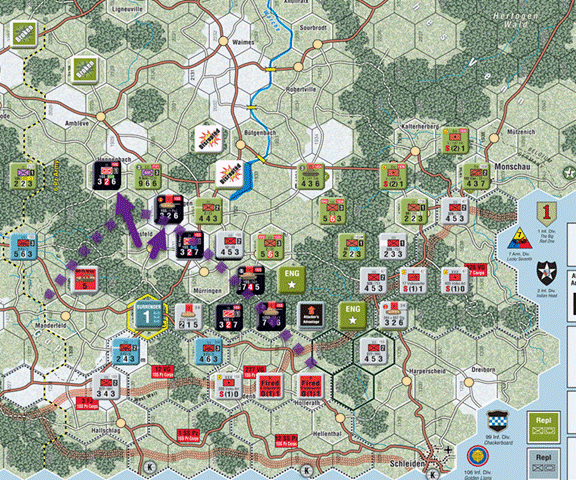
St Vith sector — pressure building from two directions. 9th Armored CCA is the last organized obstacle.
The Armor Problem
Too Much Punch, Too Little Space
I hate this part of the map. That’s honest and worth saying plainly, LOL you know me. Sigh. The center-south sector is where you have substantial German armor committed to terrain that absolutely refuses to cooperate. The Ardennes was not tank country in December 1944 — it was a network of narrow trails, dense forests, and frozen streams that turned armored columns into single-file traffic jams. The game represents this faithfully and it is maddening. Throw in roadblocks etc and GRRRRR.
We peck away. Three exchanges, three armor steps lost. In the context of the campaign this is a troubling ledger. German armor steps are finite, replacements are limited, and the Allied reinforcement schedule will bring American armor onto this board in numbers the Germans cannot match. Every step lost here is a step unavailable later when it matters most.
Three exchanges. Three armor steps. This may well be a short game. The math is not on our side if this pace continues. Or its a pet peeve for me with this CRT.
This is the essential tension of every Bulge game played from the German perspective. You have a finite window of superiority — roughly the first four to six turns before American reinforcements flood the board and Allied air power returns (weather permitting) to punish movement. Inside that window you have to achieve enough geographic gains to make the endgame VCs achievable. Outside that window, you are fighting a losing war of attrition against an opponent with deeper resources in nearly every category.
We will see how this unfolds. The 16th is behind us. The 17th awaits.
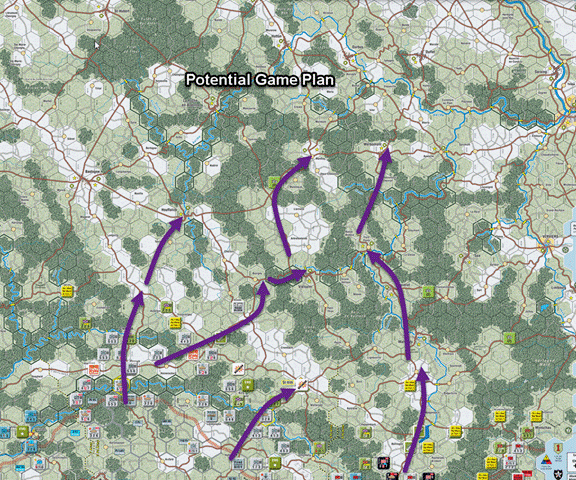
The armor bottleneck — German strength without the space to use it.
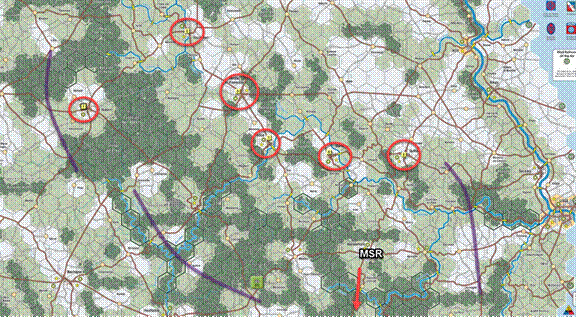
End state, 16 December — Kampfgruppe Peiper’s corridor and the road ahead.
Up Next: 17th December — Peiper breaks loose, Bastogne looms.
BigBoard Gaming